The superstition that Egyptians steal children
The Hunchback of Notre DameThe superstition that Egyptians steal children is a tale within the novel and a force within its plot: a child vanishes after her mother visits a band of travelers, and a different infant is found in her place. The account never verifies the supernatural explanations attached to the disappearance. Instead, it shows how suspicion hardens into certainty, how a bereaved mother’s unresolved loss becomes a public accusation, and how that accusation resurfaces when the recluse sees Esmeralda.
Rumor and the public image of the travelers
Mahiette recounts the story of Paquette la Chantefleurie and her daughter Agnes to explain why the child’s little shoe matters. In her account, the Egyptian and Bohemian band arrives in Reims as outsiders: sun-browned, itinerant, and led by a duke and counts. The tale describes the travelers through the hostile language of townspeople who regard them as excommunicates and attribute their customs and appearance to foreign, supposedly suspect beliefs. Such descriptions establish the prejudice surrounding the group, not reliable evidence of collective guilt.
The travelers are at once excluded and made into a spectacle. Reims forbids them from entering, yet townspeople flock to their camp outside the gate of Braine to have their palms read. Their prophecies enthrall visitors, including mothers eager to hear of their children’s futures. The same public that seeks out the travelers’ predictions circulates stories that they steal children, cut purses, and consume human flesh. Mahiette presents this contradiction as an infatuation: curiosity draws people in, while fear supplies increasingly monstrous explanations for what they encounter.
The novel also places this image in a broader public spectacle. At the procession arriving at the Place de Grève, the Egyptian Duke rides at the head of the Egyptian contingent, attended by counts, while families and children follow amid the ragged crowd. Their appearance is part of a display that gathers together people classified as outsiders and social outcasts. The procession does not establish the child-theft accusation as fact; it shows how the group is publicly represented and watched.
Agnes's disappearance in Mahiette's account
Paquette takes Agnes to the travelers because she wants to learn what her daughter’s future will be. The women in the band admire and kiss the child, especially praising her feet and shoes. Their attention delights Paquette rather than alarming her. After hearing predictions of beauty, virtue, and queenship, she returns home pleased with the future imagined for Agnes.
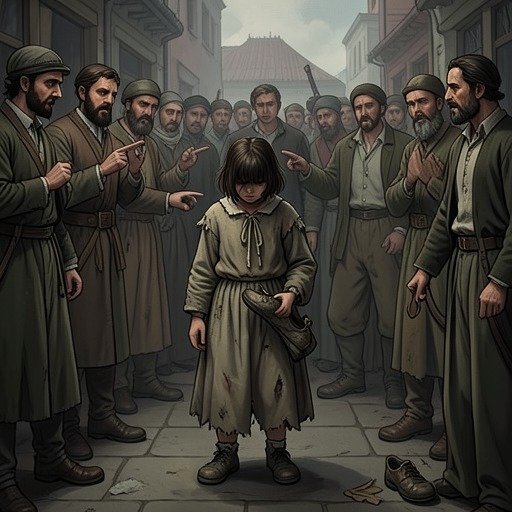
The disappearance occurs the next day. While Agnes sleeps, Paquette leaves their room briefly to tell a neighbor about the prophecies. On her return, the door stands farther open than she left it, and the bed is empty except for one of the child’s shoes. She searches the town in distress, but no one can tell her what happened. The missing child and the surviving shoe become the concrete center of a story otherwise crowded with rumor and supernatural interpretation.
Later, a neighbor reports seeing two travelers go up to Paquette’s room carrying a bundle and come back down after closing the door. Afterward, cries are heard from inside. Paquette rushes upstairs and finds another infant in the room, not her daughter. The account thus supplies grounds for suspicion that a child was taken and an infant left behind, but it does not show the abduction itself or establish who carried it out. The gap between the neighbor’s report and the town’s certainty is crucial: the rumor expands beyond what anyone can verify.
The travelers have already left Reims. A search the next morning finds a fire’s remains, ribbons said to have belonged to Agnes, traces of blood, and a ram’s dung on a heath. These objects are interpreted through the prevailing accusations as proof of a demonic gathering and the child’s death. Mahiette reports that no one doubted this explanation, but the details she gives do not independently confirm the story of a ritual or reveal Agnes’s fate. The community’s conviction and the evidence it invokes are presented together, allowing the tale to expose how fear turns ambiguous signs into apparent certainty.
The shoe, grief, and unresolved loss
When Paquette sees the unfamiliar infant, she rejects it as the child she had cherished and clings to Agnes’s remaining shoe. Her response shifts the story from communal gossip to intimate bereavement. The shoe is not evidence that can identify a culprit or recover the missing child; it is the sole object that connects Paquette to the daughter who has disappeared. Mahiette remembers Paquette kissing it and grieving, and her recollection remains emotionally powerful enough to affect the women listening years later.
The story offers no confirmed resolution to Paquette’s search. After the travelers’ departure, she hears the town’s claims about what happened, grows silent, and disappears the following day. When Gervaise later asks what became of her, Mahiette can only say that no one ever found out. The unresolved ending preserves the distinction between the mother’s real loss and the explanatory legends imposed upon it. Agnes is gone; the accusation supplies an answer, but not a verified account of her fate.
Esmeralda and the return of the accusation
Mahiette’s tale shapes how the women interpret Esmeralda. After hearing it, Gervaise suggests that Esmeralda might also eat children and treats the tricks of her goat as further evidence of impiety. This leap does not arise from demonstrated harm by Esmeralda. It transfers the old fear associated with the Egyptian and Bohemian band onto a young woman who is already viewed through suspicion and exoticizing stories. The child-theft myth therefore operates as more than background: it primes the listeners to regard Esmeralda as dangerous before the narrative has established any such act.
The recluse’s response makes the connection between the two stories visible. When she sees a child nearby, she trembles and warns the women to take the child away because she believes an Egyptian woman is passing. Soon afterward, the sight of Esmeralda at the pillory triggers a furious accusation: the recluse recognizes her as the child-stealer she believes took her daughter. The scene joins the two narrative threads—the recluse’s secluded life and Esmeralda’s public punishment—through a mistaken or unverified identification shaped by years of grief and inherited suspicion.
Narrative significance
The superstition’s force lies in the way it converts uncertainty into a lasting social judgment. In Mahiette’s story, a missing child, a neighbor’s observation, an unfamiliar infant, and objects found outside town are woven into a confident account of supernatural crime. Later, Gervaise applies the same logic to Esmeralda, while the recluse’s accusation turns her private bereavement into a public charge. The novel allows the fear to drive recognition and conflict without confirming the lurid explanations circulated about the travelers.
This pattern also reveals the workings of Anti-Romani prejudice and persecution: outsiders are denied entry, scrutinized when they attract curiosity, and blamed through rumors that exceed what witnesses can establish. The narrative records those accusations as part of the characters’ world rather than endorsing them as fact. Even the supposed prophecies and ominous predictions belong to a setting where people readily grant authority to supernatural claims; elsewhere, Master Robert Mistricolle confidently forecasts misfortune for a foundling by interpreting a mark on the child as a sign of nested demons. Against that atmosphere of credulity, the lasting force of Agnes’s missing shoe is not that it proves the rumor, but that it preserves the human loss the rumor claims to explain.